
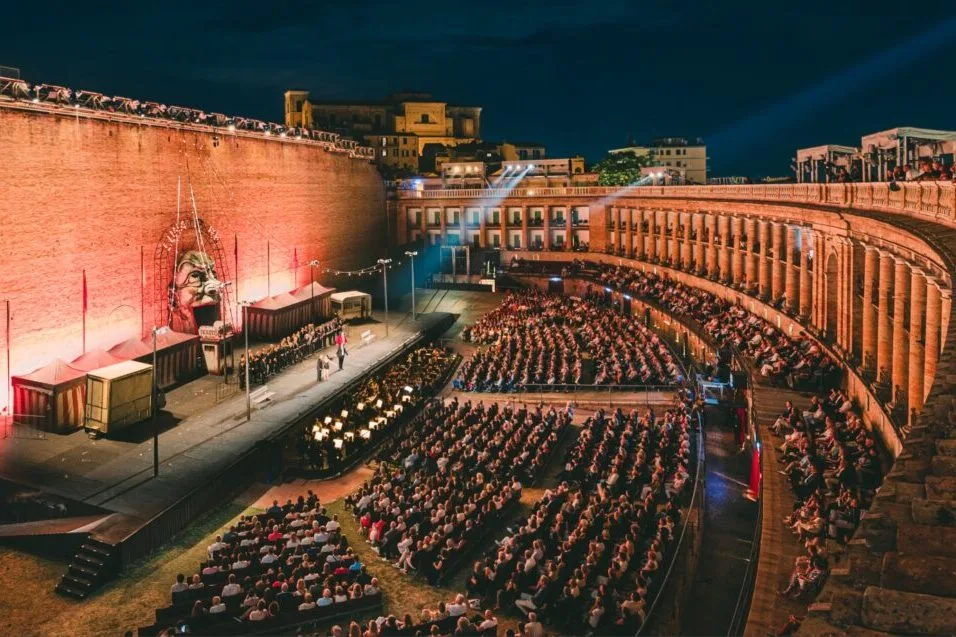
The Sferisterio Macerata is one of the most distinctive open-air opera venues in Italy, and the stage of the internationally recognised Macerata Opera Festival. Every summer, this monumental arena hosts productions that bring together music, architecture, and atmosphere in a way few venues can match.
The festival programme often features iconic works such as Nabucco and Il Trovatore by Giuseppe Verdi, alongside classics like Il Barbiere di Siviglia. These operas, defined by powerful choruses, dramatic narratives, and memorable arias, find a particularly striking setting in the Arena Sferisterio, where the scale of the space enhances both sound and staging. Watching an opera here is not just a performance, but an immersive experience shaped by light, acoustics, and the open sky.

Accommodations Near the Sferisterio
If you’re travelling to attend an event at the Sferisterio, browse the map below to find accommodation nearby.
History and Origins of the Sferisterio
The Sferisterio was inaugurated in 1829, originally built not for opera but for a traditional ball game known as pallone col bracciale. Its name derives directly from this function. The structure was commissioned by local patrons and designed by architect Ireneo Aleandri, who created a venue that combined functionality with monumental presence.
By the early 20th century, the space began to transition into a cultural venue, eventually becoming one of Italy’s most important stages for opera. Its transformation into the home of the Macerata Opera Festival established it as a reference point for summer opera seasons in Europe.
Architecture of the Arena Sferisterio
What makes the Arena Sferisterio unique is its architectural configuration. Rather than a traditional amphitheatre, it features a long, straight stage backed by a monumental neoclassical wall with a series of arches and columns. This creates a striking visual perspective and an exceptional acoustic environment.
The arena is approximately 90 metres long, with a wide performance area that allows for ambitious сценography and large-scale productions—ideal for operas like Nabucco or Il Trovatore, where choruses and spatial dynamics are central.


The seating, arranged in a gentle curve opposite the stage, ensures clear sightlines and contributes to the intimate yet grand atmosphere. Despite its size, the Sferisterio Macerata maintains a strong connection between performers and audience, which is one of the reasons it is so appreciated by both directors and opera lovers.
Why Visit the Sferisterio in Macerata
- One of Italy’s most unique open-air opera venues
- Home of the Macerata Opera Festival, featuring works by Giuseppe Verdi and other major composers
- Exceptional acoustics without heavy amplification
- Monumental architecture combined with a minimalist stage concept
- Central location in Macerata, within walking distance of the historic centre
What to See Near the Sferisterio
Within a few minutes’ walk from the Sferisterio Macerata, you can explore the compact historic centre of Macerata, where most highlights are concentrated.
Start from Piazza della Libertà, the main square and natural hub of the city, surrounded by elegant buildings and cafés, ideal for a pre-opera aperitivo. Nearby, the Teatro Lauro Rossi offers a more intimate theatre setting, often hosting concerts and cultural events.
Continue towards the Loggia dei Mercanti, a refined Renaissance structure that reflects the city’s commercial past, and the Duomo di Macerata (Cathedral of San Giuliano), located on a hill with views over the surrounding countryside.
The streets connecting these landmarks are part of the experience: quiet, well-preserved, and easy to explore on foot before or after an evening at the Arena Sferisterio.

What to See Near Macerata
Beyond the city, the area around Macerata offers a mix of countryside, historic villages, and natural landscapes, all within a short drive.
- A few kilometres away, the Abbadia di Fiastra is one of the most important monastic complexes in central Italy, surrounded by a large nature reserve with walking and cycling paths. (See Easy Hikes in Le Marche with Maps, and Easy Hikes in Le Marche, Suitable for Kids).
- For nature, head towards the Monti Sibillini National Park, known for its wide open landscapes, hiking trails, and seasonal highlights like the flowering plains of Castelluccio.
- Literary and cultural interest leads to Recanati, birthplace of poet Giacomo Leopardi, with panoramic views over the hills.
- Cingoli, known as the Balcony of Le Marche.
- Closer still, the Urbisaglia Archaeological Park preserves remains of a Roman colony, including a theatre and city walls, an easy and worthwhile stop.
- You can find more travel inspiration and borghi to see in Le Marche in this article.
- Tickets for events in Le Marche.
Comments are closed.