
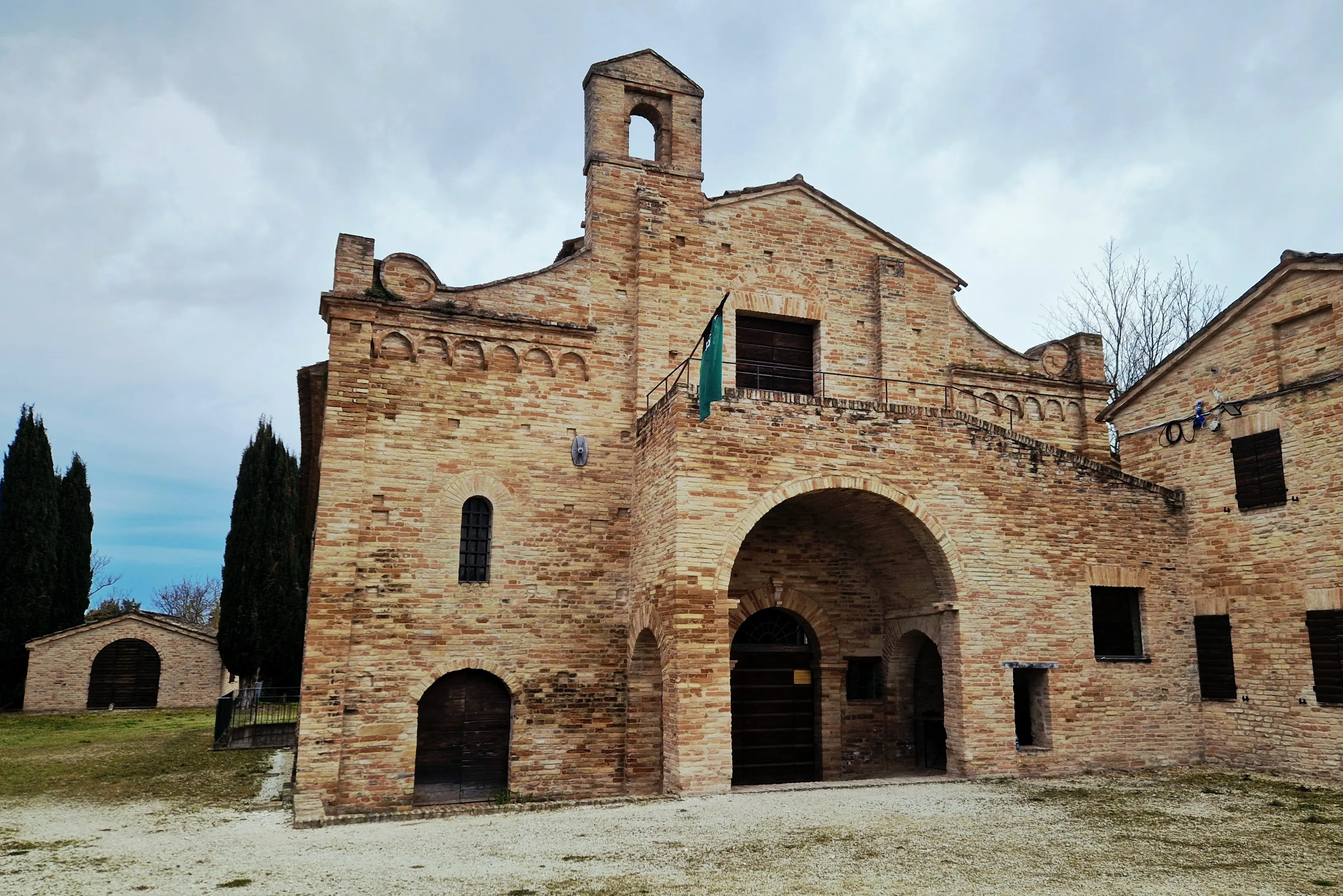
Lost among country lanes in the countryside of Sant’Elpidio a Mare, near the river Chienti, stands a small abbey.
At first glance, it doesn’t look like much. For over two centuries, from 1790 to 2006, it was used as a granary, stripped of its original function and almost forgotten.
And yet, behind those walls lies over 1,500 years of history.


The consecration and early history
Its story began long before its official recognition. The abbey was formally consecrated on 14 September 887, in the presence of Emperor Charles the Fat, the Bishop of Fermo Theodosius, and a remarkable assembly of 19 bishops and 27 canons. This event placed Santa Croce al Chienti within a wider political and religious system linked to imperial power and the consolidation of monastic institutions in central Italy.
Over the following centuries, the abbey grew into a religious and economic centre, contributing to the organisation of the territory and the transformation of the surrounding land. With a papal bull dated 12 September 1197, Pope Celestine III placed the abbey under his protection. The abbey also became a key crossroads for the papal army, serving as a provisioning point thanks to local grain reserves, and supplying footwear to troops; likely an early precursor to what would later develop into an internationally recognised shoe-making district.
Then, slowly, it declined, its role diminished in favour of the Abbazia di Fiastra, its structures repurposed, until it disappeared from the main currents of history. However, recent excavations have revealed that beneath the church lies an earlier early Christian structure, even older than the basilica.

The story of Lotario and Imelda
The story of the Abbazia di Santa Croce al Chienti, also know as Basilica Imperiale di Santa Croce al Chienti, begins with Lotario, a young knight from Ascoli, and Imelda, daughter of Eufemio, a local feudal lord.
They fell in love, but her father opposed the marriage; to prevent them from seeing each other, Imelda was locked away in a convent.
Lotario searched for her across the surrounding lands, moving from one fief to another, without ever finding her.
Imelda, isolated and consumed by grief, died in the convent.
Lotario learned of her death too late.
From revenge to redemption
Driven by rage, Lotario confronted Eufemio, one late afternoon, in front of his house, he killed him, driving a dagger into his chest.
But revenge brought nothing back; remorse took over.
Lotario abandoned everything and began to wander, searching for a place far from men, across the hills and countryside of Marche. He finally stopped on the banks of the Chienti river.
There, according to tradition, he built the Abbazia di Santa Croce al Chienti as an act of penance, a way to atone and seek redemption.
Where is the Abbazia di Santa Croce al Chienti Located?
Today, the Abbazia di Santa Croce al Chienti, in Sant’Elpidio a Mare, stands between the Chienti river and the Ete Morto. Its history tells of a heartbreaking love, violence, redemption, emperors, and monastic power.
Together, they make this one of Marche’s most distinctive yet little-known historical sites.

Places to visit nearby
The area around the Abbazia di Santa Croce al Chienti offers several places worth a short detour.
- Torre di Palme: a small hilltop village overlooking the Adriatic, ideal for a romantic dinner or an aperitif at sunset, with views stretching along the coast.
- Fermo: one of the main historic towns in southern Marche, with Piazza del Popolo, Roman cisterns, and a layered history spanning centuries.
- Abbazia di Fiastra: a well-preserved Cistercian abbey set within a large natural reserve, ideal for a slower visit combining history, nature, and walking trails.
- Gradara: a perfectly preserved medieval town, known for the story of Paolo and Francesca and dominated by its impressive castle walls. Home for another well-known love story, but at a 2 hour drive.
Comments are closed.