
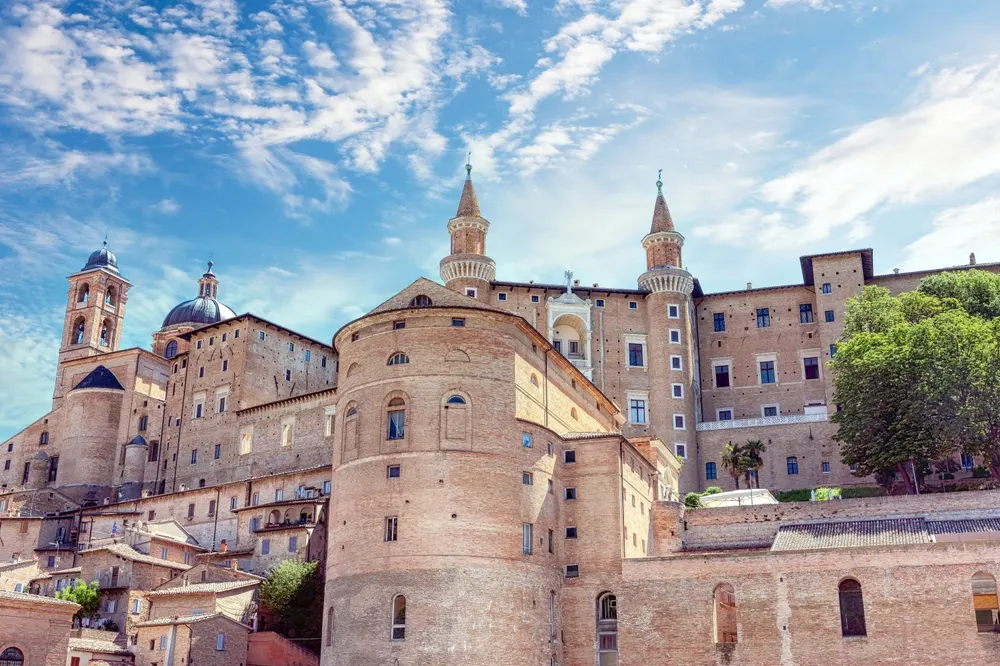
Urbino in Le Marche, is one of the most important UNESCO sites in Italy and a key destination for exploring the Italian Renaissance beyond the usual tourist routes. Perfectly preserved and deeply connected to Renaissance art and urban planning, Urbino offers a compact historic centre where palaces, churches, and viewpoints can be explored entirely on foot.
The city is also known worldwide as the birthplace of Raphael, whose early life and work remain closely tied to Urbino’s identity. This travel guide focuses on the essential things to do in Urbino, providing practical context for visitors interested in Renaissance Italy, UNESCO heritage, and one of central Italy’s most culturally significant cities.

Where is Urbino Located?
Urbino is located in northern Le Marche, set in the hills between the Adriatic coast and the Apennines. It is about 45 minutes by car from Pesaro, 1 hour from Rimini, 1 hour 40 minutes from Bologna, making it an easy stop on itineraries linking the coast with central Italy’s historic cities.
Things To Do in Urbino


Explore the Historic Centre and Palazzo Ducale
Urbino’s historic centre is a UNESCO World Heritage Site and is best explored on foot. The Palazzo Ducale is the city’s main landmark and one of the finest Renaissance palaces in Italy. Its distinctive Rampa Elicoidale, designed to allow horses and carts to access the palace, reflects Urbino’s advanced Renaissance urban planning. Inside, the Galleria Nazionale delle Marche (National Gallery of Le Marche) houses one of central Italy’s most important Renaissance art collections.
Discover Raphael’s Urbino
Urbino is the birthplace of Raphael, born here in 1483. The Casa Natale di Raffaello (Raphael’s Birth House) offers insight into his early life and artistic training. Walking through the surrounding streets helps place his work within the intellectual environment that shaped the Italian Renaissance.

Churches and Oratories
The Oratorio di San Giovanni Battista is known for its 15th-century fresco cycle depicting the Crucifixion, while the nearby Oratorio di San Giuseppe preserves a rare stucco Nativity scene attributed to Federico Brandani. The Cattedrale di Santa Maria Assunta dominates the historic centre with its neoclassical interior and remains one of Urbino’s main religious landmarks.


Green Spaces and Viewpoints
The Orto Botanico di Urbino (Bothanical Garden), managed by the University of Urbino, is located just outside the historic centre and focuses on the conservation and display of native and Mediterranean plant species rather than panoramic views. For open views over the city and the surrounding hills, Parco della Resistenza is a well-known viewpoint near the historic centre, offering clear sightlines across Urbino’s rooftops and landscape.
Finally, don’t miss the view from Fortezza Albornoz. It is the highest point above Urbino’s historic centre and is one of the city’s most important defensive structures. Built in the 14th century and later modified, the fortress reflects Urbino’s strategic role before the Renaissance transformation of the city. Today, the site is primarily known for its elevated position, offering clear views over Urbino’s historic centre.


Explore The Surroundings
Urbino is well positioned for exploring northern Le Marche and nearby Emilia-Romagna.
Urbania, around 20 minutes away, is closely linked to Urbino’s history and ducal heritage, while Pesaro, about 45 minutes by car, connects the area to the Adriatic coast. Within roughly one hour, Gradara and Corinaldo offer two of the region’s best-known historic towns, each with a distinct medieval layout.
During the Christmas period, a short trip to Mombaroccio is also worth considering for its seasonal events and historic centre.
Accommodations in Urbino
You can find many accommodations near Urbino following the links below:
Comments are closed.