
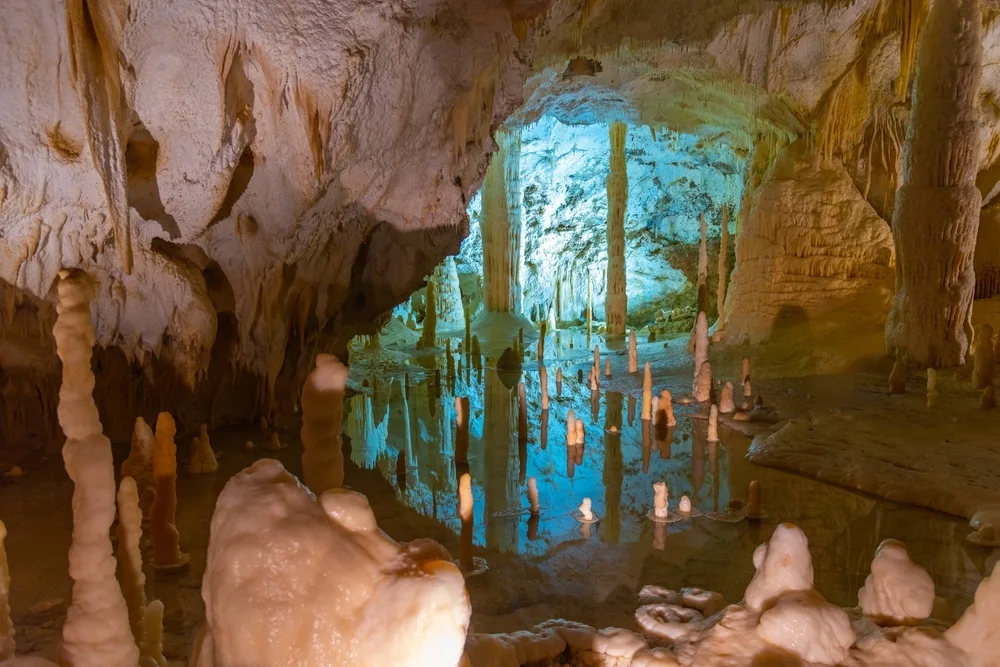
Hidden beneath the rolling hills of central Italy, the Grotte di Frasassi (Frasassi Caves) are one of Europe’s most extraordinary natural wonders. This underground world, carved over 150 million years, is waiting to astonish you.
Accessible to all ages and genuinely thrilling for families, it is also one of Italy’s most rewarding day trips off the beaten path.
What Are the Grotte di Frasassi?
The Frasassi Caves are a vast karst cave system located in the municipality of Genga, in the province of Ancona, in the Marche region of central Italy. They are widely considered among the largest and most beautiful show caves in all of Europe.
The full official name of the system is Grotta del Fiume, Grotta Grande del Vento di Frasassi, though most visitors and locals simply call them Le Grotte or Frasassi. The accessible tourist route winds through approximately 1.5 kilometres of breathtaking underground chambers, while the full cave network extends for over 30 kilometres across eight geological levels.
The star of the show is the Abisso Ancona (Ancona Abyss), a single cavern so immense it is often compared in size to the Duomo di Milano. Standing inside it, you will understand why immediately.

What to See Inside: The Main Chambers
The standard tourist route (approximately 1.5 km) passes through a sequence of named chambers, each with its own character:
- Abisso Ancona (Ancona Abyss): The first stop and the most jaw-dropping. Measuring roughly 180 × 120 metres at the base and nearly 200 metres tall, this is one of the largest single underground chambers in Europe. It was here that a team of speleologists from the Club Alpino Italiano, during their landmark 1971 exploration, first encountered the towering stalagmites — some reaching nearly 20 metres — known simply as “the Giants.”
- Grotta Grande del Vento (Great Cave of the Wind): The main cave of the tourist route, with approximately 13 kilometres of passageways in total. Its name comes from the strong air currents that early explorers felt at its entrance.
- Sala delle Candeline (Room of the Candles): A chamber filled with slender, delicate stalagmites that look uncannily like lit candles arranged in rows — one of the most photogenic spots in the entire system.
- Sala dell’Infinito (Room of the Infinite): A tall chamber where massive columns rise toward the vaulted ceiling, creating a sense of boundless, cathedral-like space.
- Sala dell’Orsa (Room of the Bear): Home to a rock formation that looks strikingly like a bear — a favourite with younger visitors.
- Gran Canyon: An area whose walls, gorges, and crevices evoke the landscape of the American Southwest, on a subterranean scale.
- Niagara Falls: A massive cascade of pure white calcite flowing down a cave wall like a frozen waterfall — one of the most striking mineral formations in the system.
Throughout the route, a thoughtfully designed lighting system highlights different formations and textures, turning the underground walk into a genuinely theatrical experience.
Practical Information, Opening Hours, What to Wear, Tickets, Best Time to Visit
- Opening Hours: the caves are open to the public year-round, with guided tours departing at regular intervals throughout the day. Hours vary by season; check the official Frasassi website for up-to-date schedules before your visit.
- Tickets and Prices: the standard guided tour costs approximately €20 per person (at the time of writing). Reduced rates are available for children. Speleo-adventure tours are priced separately and require advance reservation.
- What to Wear: the caves maintain a constant temperature of 15°C regardless of the season — cool enough to feel genuinely cold if you arrive unprepared. Even in the height of an Italian summer, bring a light jacket or layer. Wear comfortable, closed-toe shoes with good grip, as some paths can be damp.
- Best Time to Visit: the caves are open all year, but spring (April–June) and autumn (September–October) are the optimal seasons. Crowds are smaller, the surrounding nature park is at its most beautiful, and the weather is ideal for combining your cave visit with outdoor activities. Summer weekends can be very busy, and booking ahead is strongly advised.
- Photography: photography is permitted inside the caves. The dramatic lighting system offers excellent creative opportunities — a wide-angle lens or smartphone night mode works particularly well.
- Accessibility: the standard tourist route is largely accessible via elevated walkways, making it suitable for most visitors. However, the terrain may pose challenges for wheelchair users; contact the visitor centre in advance to check current accessibility conditions.
- Getting from the Car Park to the Cave Entrance: the ticket office, car park, and cave entrance are not at the same location. A shuttle bus service connects them and is included with your ticket. Allow extra time for this transfer, especially during busy periods.


Beyond the Caves: What Else to See Near Frasassi
A visit to the Grotte di Frasassi pairs beautifully with exploration of the wider area — one of the most underrated corners of Italy.
- Tempio del Valadier (Temple of Valadier): A striking neoclassical chapel from 1828, also built into a rocky outcrop near Genga. The setting is extraordinary.
- Gola della Rossa and Frasassi Regional Nature Park: The gorge itself is outstanding hiking and cycling territory. The dramatic limestone walls tower above the Sentino River, offering some of the finest scenery in the Marche Apennines.
- Fabriano: Just 15 minutes away, this historic town is famous for its centuries-old tradition of papermaking and is home to the excellent Museo della Carta e della Filigrana (Museum of Paper and Watermarks). The central Palazzo del Podestà is also worth a visit.
- Cingoli: known as the Balcony of Le Marche for a reason.
- Arcevia: preserved medieval borgo with its nine castles.
Frequently Asked Questions About the Grotte di Frasassi
- How long does a visit to the Grotte di Frasassi take? The standard guided tour lasts just over one hour. Allow an additional 30–45 minutes for transfers, queuing, and orientation. A half-day is comfortable; plan a full day if you want to explore the gorge and surrounding area as well.
- Are the Frasassi caves suitable for children? Yes — the standard tour is family-friendly and suitable for all ages. The spelunking Blue Path is currently available for children aged 12 and above; confirm the minimum age when booking.
- Can I visit the Grotte di Frasassi without a car? Yes. The Genga-San Vittore train station on the Rome–Ancona line is within easy reach of the visitor centre, and a shuttle bus takes you to the entrance. It is one of the more train-accessible natural attractions in central Italy.
- Do I need to book tickets in advance? For the standard tour, advance booking is recommended in peak season (July–August) and on weekends. For spelunking tours, advance booking is always required.
- Is the temperature inside really that cold? At 14°C, the caves feel noticeably cool — especially if you have been walking in Italian summer heat. A light jacket is genuinely useful, not just precautionary.
- Are the Grotte di Frasassi the largest caves in Italy? They are among the largest cave systems in Italy and Europe, with over 30 kilometres of mapped passages. The Ancona Abyss is one of the largest single underground chambers on the continent.
Comments are closed.