
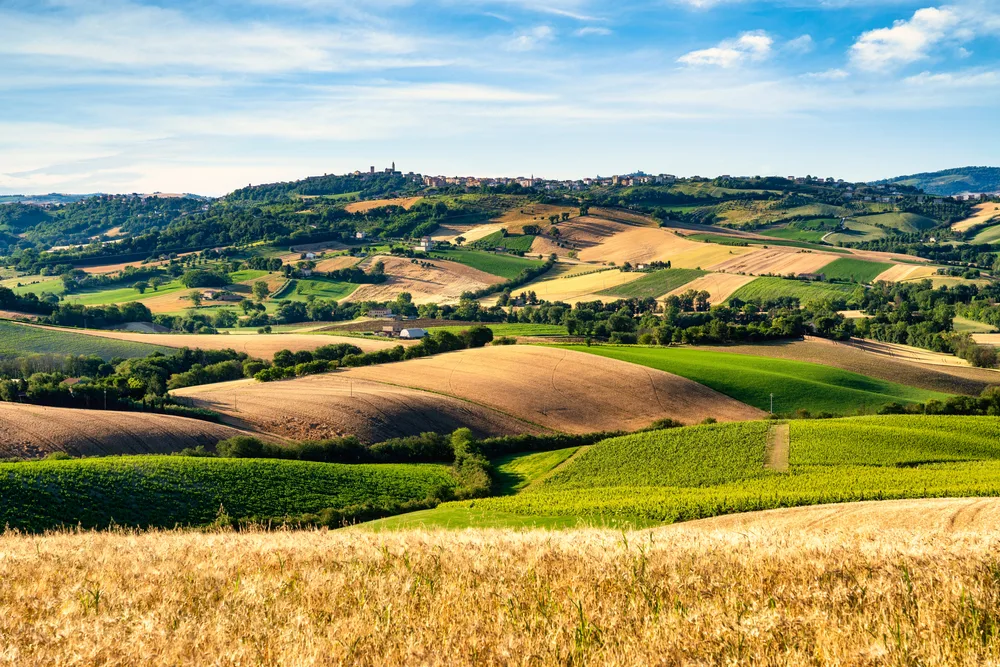
Le Marche stretches from the Adriatic coast to the Apennines, with farmland, vineyards and hilltop towns in between. Its main places to visit include Urbino and Ascoli Piceno, the beaches around Monte Conero, the Frasassi Caves and the Sibillini mountains. There are also smaller villages, religious sites and wine-producing areas across the region.


A holiday here can combine several of these without changing accommodation every day. Where you stay matters, though: exploring the villages around Fermo is a different trip from visiting Urbino and the northern coast. This guide gives you an overview of what there is to see and links to more detailed guides.
Borghi and historic towns in Le Marche
Many of the region’s smaller historic towns are built on hills, with streets leading between squares, churches, town gates and viewpoints. They are often referred to as borghi, although they differ considerably in size and character.


In northern Le Marche, Gradara is known for its castle and fortified centre. Corinaldo has extensive town walls and a long central stairway, while Arcevia can be explored alongside its nine surrounding fortified villages.
Further inland, Cingoli is called the “Balcony of Le Marche” for its wide views across the region. Near Ancona, Offagna is dominated by its 15th-century fortress.
Around Fermo and the Aso Valley, you can visit several smaller towns within the same area. Torre di Palme overlooks the Adriatic, while Moresco has a compact centre beneath its seven-sided tower. Nearby are Monterubbiano, Petritoli and Montefiore dell’Aso. Further inland, Santa Vittoria in Matenano is another town to include when exploring the hills.
In the south, Offida is known for bobbin lace, its historic carnival and local wine. Ripatransone overlooks the surrounding countryside and vineyards. Grottammare Alta and Marano, the old town of Cupra Marittima, sit above the coast, making them easy to combine with a seaside stay.
For a visit closer to the mountains, consider Sarnano, with its brick-built medieval centre at the foot of the Sibillini, or Frontino in northern Le Marche.
Urbino and Ascoli Piceno
Urbino is one of the region’s main destinations for Renaissance art and architecture. Its historic centre is a UNESCO World Heritage Site, and the Palazzo Ducale houses the Galleria Nazionale delle Marche. Raphael was born here, and his birthplace is open to visitors.


Ascoli Piceno has a different appearance, with pale travertine buildings, medieval towers and squares. Piazza del Popolo is the best-known, but Piazza Arringo, the Cathedral of Sant’Emidio and the streets between them are also part of a visit.
Both cities offer enough to make them destinations in their own right, rather than brief stops on a tour of smaller villages.
Beaches in Le Marche
The coast includes sandy resort beaches, stretches of pebbles and gravel, and smaller bays beneath cliffs. Beach clubs and free beach areas are common, but facilities and access vary by location.


Senigallia and San Benedetto del Tronto are options for long sandy beaches and a holiday based around the seafront. San Benedetto is part of the Riviera delle Palme, with its palm-lined promenade.
Other seaside towns include Fano, Civitanova Marche, Porto San Giorgio, Porto Sant’Elpidio and Porto Recanati. These have different beach surfaces and layouts, so it is worth looking at the particular stretch of coast near your accommodation.
- Best Beaches in Le Marche
- Riviera del Conero Beaches: Map, What to Expect & Where to Stay
- Accessible Beaches in Le Marche
The Conero coast
South of Ancona, Monte Conero rises above the sea, with beaches and bays around Portonovo, Mezzavalle, Sirolo and Numana. Due Sorelle and Spiaggia dei Gabbiani are also along this coastline.


Access is an important part of choosing a Conero beach. Some locations have beach clubs and road access nearby; others involve a steep walk or access by sea. A beach that looks appealing in a photograph may require more effort to reach than you expect.
Our Conero beach guide covers the differences between locations. You can also browse our beach guide for Le Marche, quieter beach locations and accessible beaches.
Hiking and long-distance walking
The Monti Sibillini National Park is one of the main hiking areas in Le Marche. It includes peaks such as Monte Bove, Monte Sibilla and Monte Vettore, along with valleys and mountain landscapes that differ considerably from the coast.


Towns and villages such as Montefortino, Ussita and Bolognola are places to explore around the mountain area. Walking routes range from shorter outings to demanding mountain hikes, so the distance alone is not enough to judge their difficulty.
Conero Park and Monte San Bartolo offer another kind of walking, with routes overlooking the Adriatic. For shorter outings, see our easy hikes and walks suitable for kids.
Le Marche also has longer cammini crossing villages, countryside and religious sites. These can form the main part of a walking holiday or be explored in shorter sections. Our cammini guide introduces several routes, including options for multi-day journeys.
Along the coast, the Cammino della Sirena Mitì links San Benedetto del Tronto and Sirolo.
Frasassi Caves and the Temple of Valadier
The Frasassi Caves are near Genga, inland from Ancona. Visits follow an underground route through chambers containing stalactites and stalagmites.


Nearby, the Temple of Valadier stands inside a large cave entrance. The cave tour and the walk to the temple are separate visits, but both can be included in a day around Genga.
This area offers a change from the region’s coastal towns and hilltop villages, especially if you want to include an inland excursion in your trip.
Wine in Le Marche
Wine production is spread across the region, from the hills near Ancona to the countryside around Offida.
Verdicchio dei Castelli di Jesi and Verdicchio di Matelica are among its best-known white wines. Rosso Conero comes from the area around Monte Conero, while Lacrima di Morro d’Alba is associated with the hills north of Ancona. In southern Le Marche, Pecorino and the wines of Offida are further options to try.
A winery visit gives you a reason to explore the surrounding countryside as well as taste the wine. Depending on the producer, visits may include a cellar tour, a tasting or food pairings.
See our wine tasting guide for wineries and experiences across the region.
Food to try
Olive all’ascolana are meat-stuffed olives, breaded and fried, associated with Ascoli Piceno. Vincisgrassi is a baked pasta dish made with layers of pasta and meat sauce.


You will also find tagliatelle and porchetta, while coastal cooking includes fish and seafood. Brodetto, a fish soup, has different local versions along the Adriatic.
Food is worth considering when choosing where to stop: a visit to Ascoli can include olive all’ascolana, while a day on the coast offers a chance to try local seafood dishes.
Art, festivals and religious sites
Art and historic buildings are spread across Le Marche. Alongside Urbino and Ascoli Piceno, cities such as Ancona, Fermo and Macerata can be included according to the area you are visiting.


Loreto is home to the Basilica della Santa Casa, an important Catholic pilgrimage site. Fabriano is associated with papermaking, while the area around Serra San Quirico offers further historic and religious places to explore.
For opera, the Sferisterio in Macerata is one of the region’s main venues. In Senigallia, the Summer Jamboree focuses on American music and culture of the 1940s and 1950s.
Festivals can be a reason to choose a particular town or time of year. Check the programme and dates before booking around an event.
How to get to Le Marche
Ancona Airport (AOI) is the region’s airport and an option for stays on the central coast and nearby inland areas.
Pescara, Bologna and Perugia are alternatives, depending on your flights and destination. Rome may also work, but the onward journey varies substantially according to which part of Le Marche you are visiting.
Use our flight comparison page to compare options.
Travelling around the region
The Adriatic railway connects coastal towns including Pesaro, Fano, Senigallia, Ancona, Civitanova Marche and San Benedetto del Tronto. Trains can work well for a holiday based on the coast.
Inland villages and mountain areas are generally easier to explore by car, particularly if you want to visit several places in a day. Travelling without one is possible on some routes, but check the available connections before choosing your accommodation.
You can compare journeys through our train search and vehicles through our car hire page.
Accommodation in Le Marche
Accommodation includes hotels, B&Bs, holiday homes, agriturismi, campsites and bungalows. You can find and compare Le Marche hotels and accommodations using our interactive map.
Coastal towns such as Senigallia, Civitanova Marche and San Benedetto del Tronto offer places to stay near the beach and town facilities. Inland, an agriturismo or countryside property can be a base for visiting villages, vineyards and nearby walking routes.
For a trip focused on the Sibillini mountains, staying closer to your chosen walking area can reduce daily driving. For a mixed holiday, look at the distances between your accommodation, the coast and the inland places you want to visit.
Our accommodation map lets you compare properties by location.
Guided visits and activities
For organised tours, wine tastings and other bookable experiences, browse our activities in Le Marche.
Overall, Le Marche is an unexplored region by mass tourism, where you can travel slowly, find authenticity, and enjoy tangible experiences at an honest, affordable price.

Comments are closed.